
 Complete Guide
Inside Janam Bhumi Mathura – 7 Things to See, Entry Rules & Darshan Guide
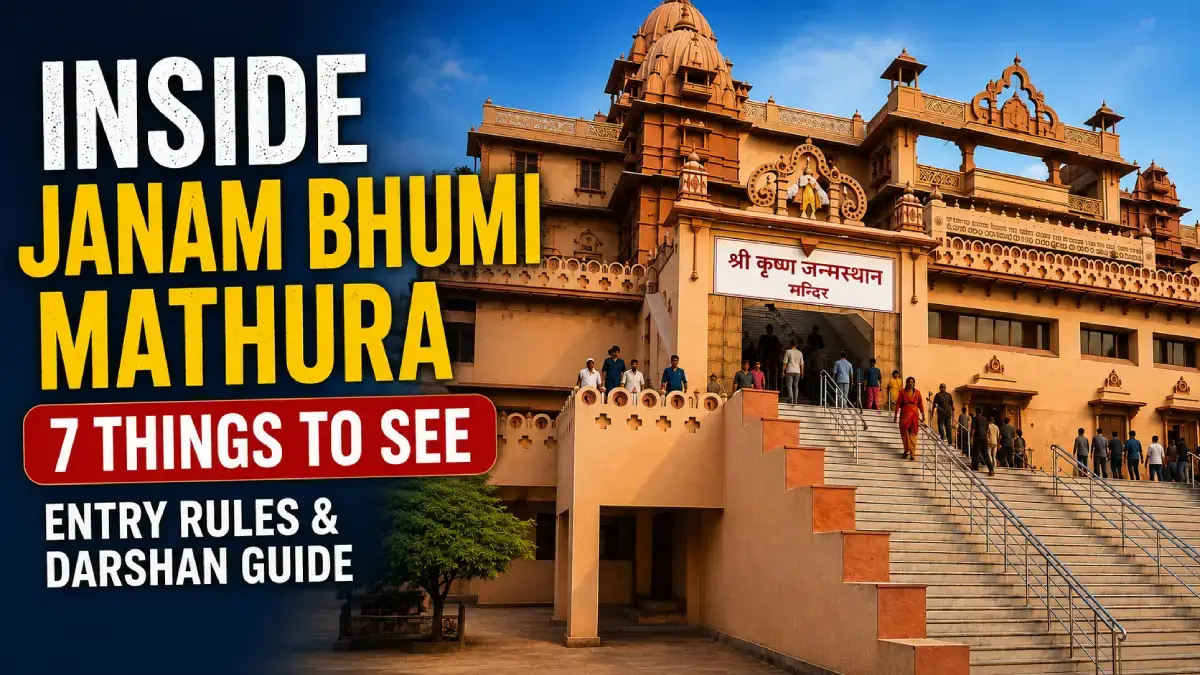
If you are going to Shri Krishna Janmabhoomi in Mathura, one question that would naturally come up is-What is actually inside Janam Bhumi Mathura? The answer is very interesting. It is not just ‘a temple’. The place actually is a great pilgrimage center with association of the traditional birthplace of Krishna where devotees visit shrines and sacred spots at Janmabhoomi complex. Probably the most important spot of the devotee is Garbhagriha which corresponds to a room where Krishna is traditionally believed to have been born as a prisoner. The complex also comprises the Keshav Dev Temple and Bhagavata Bhavan.
But a visit is not just like entering any tourist place. At the entrance there will be checks so you have to be security conscious. There are no photo-shoots either. Visitors have to decide beforehand what items to carry. The website of the Mathura district says photography inside is not allowed. Along with the inside of Janam Bhumi Mathura this guide also tells you the items which can be brought inside or will have to be left outside. You will find how the darshan works as well as some travel hacks to help the visit to be smoother.
What Is Inside Janam Bhumi Mathura?
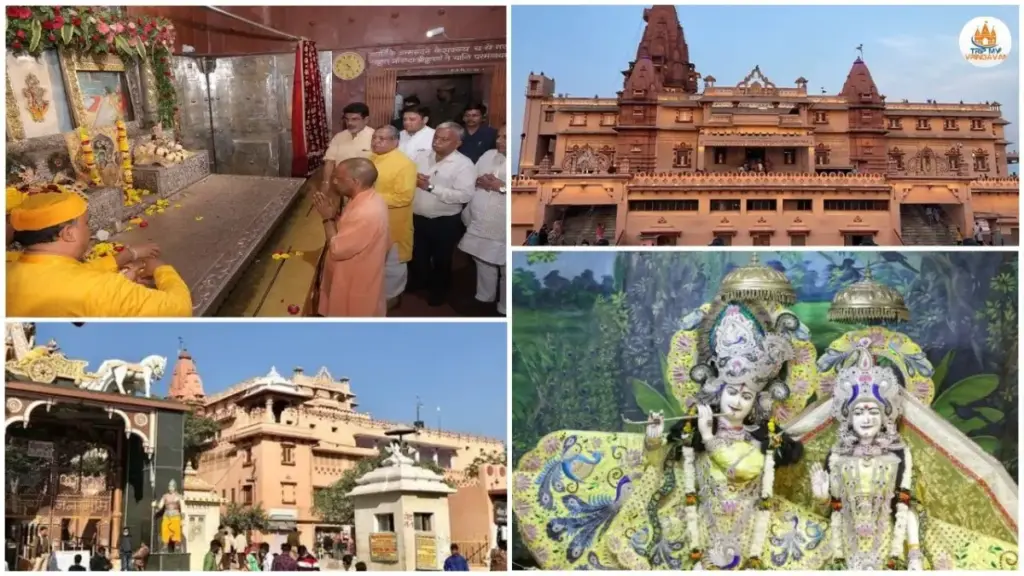
Janam Bhumi Mathura shelters various religious spots, which are important for the worship of Krishna and the history of his birth, according to tradition. The site is described by the District Mathura administration as Krishna’s birth prison house, according to the traditional legend, the same place where he was believed to have manifested himself. Besides the birthplace sanctum, the official government tourism highlights temple of Maa Yogmaya which lies in the vicinity.
This site cannot be regarded as a single small temple but as a set/pilgrim area with many religious buildings together.
Main places associated with the complex
- Garbha Griha, the holy birthplace of Krishna, according to tradition.
- Keshav Dev Temple, one of the major temples on Janmasthan premises.
- Bhagavata Bhavan, a big space for religious devotional activities.
- Small shrines and holy places, the site also hosts other Krishna and Hindu-related religious spots.
- Religious places, visitors often take part in singing devotional songs etc., depending on the days and the occasion.
It regularly publishes updates about its temple’s activities and rituals at Janmasthan on the official temple website.
What does the inside look like?
Visitors should not assume that they can take their place apart to see how it works it is purely a spiritual experience. There will be temples, gods and goddesses’ idols, the most sacred parts of a temple, long queues, darshan, several security checkpoints, and of course countless devotees who are doing their devotional rituals. For quite a few pilgrims, the main aim is to arrive in a place that is closely linked to the birth of Krishna; it is not just about architecture.
Important: Photography is prohibited Inside Janam Bhumi Mathura complex according to the District Mathura administration, so visitors should not plan on taking photographs inside.
The Entry Experience: Security and Preparation
Getting to the holy ground of Inside Janam Bhumi Mathura starts with passing through the entry procedures, just as one is usually required to do when entering a sacred place. A boundary wall that connects this religious shrine with the Shahi Idah Mosque makes it one of the places of worship with the maximum security throughout the country.
Cloakrooms and Restrictions
You will first need to check what you are carrying with you when you get to the main gate. To keep their belongings safe, the visitors can use a secure locker outside the main gateway. Leather goods along with mobile phones, cameras, smartwatches, etc. are to be left in these lockers, whereas a cloth/ plastic pouch for cash and ID cards should be very handy if not mandatory.
The Security Check
The central security authorities take charge of the safety procedures, which are very thorough, and involve metal detectors and body search. This can consume your time from 15 to 45 minutes, according to the number of people. However, the system is very efficient so it does not delay much.
7 Divine Places to Visit Around in Janam Bhumi Mathura
Now that you have passed through the security and begun the walking tour in bare feet, the surrounding modern world vanishes gradually. There are plenty of areas within Janam bhumi Mathura complex to explore as well.
1. The Sacred Garbh Griha (Prison Cell)
Being King Kansa’s prison cell, Devaki and Vasudeva took baby Krishna here in the darkness of the night, according to the traditional Hindu belief. The location in which Lord Krishna was born, Garbh Griha, is undoubtedly the most important one at this heritage temple. As you proceed to Garbh Griha along the dim corridor, you sense more or less a very silent place that can only be suitable for meditative worship.
The dungeon-like feeling which the place imitates is also reflected in the structure of it. On the platform, the point of God’s birth is indicated by a single marble spot. The people coming to visit this temple just pay a prayer, offer flowers, and home “Radhe, Radhe.” The spirit of this place is so moving that many visitors are totally blown away.
2. The Magnificent Bhagwat Bhavan
This grand temple is dedicated to Bhagwat Gita as one can tell by its name, Bhagwat Bhavan. Built in 1960s, it is one of those extraordinary temples. After entering the premises of Janam bhumi Mathura, you will see a painted ceiling depicting the important happenings in Lord Krishna’s life. In a word, you will be very amazed.
3. The Keshavdeva Temple
A little to the south of Bhagwat Bhavan, you will find the Keshavdeva Temple. This little temple has the same name as the ancient grand temple which used to be here long ago. Ramkrishna Dalmia built the present-day one at such a late stage as 1958.
There is an extremely lovely black idol of Lord Krishna (Keshavdeva) inside. The space between the temple and the courtyard is quite big so that the devotees have enough space to relax, think deeply or just do some devotional singing.
4. The Divine Cave Temple (Jhanki)
This part is for families and especially for children, who will love the Divine Cave Temple (also called Jhanki).
There is a very narrow, fake cavern system that leads people to the inner part. Here, mechanical dioramas are set up. The scenes from Krishna’s life like lifting of Govardhandhura Mountain, defeating demoness Putana, and putting multi-headed serpent Kaliya under dance, are shown and told on these automatons.
Lighting and sound effects work miracles and they are so realistic that the spectators feel that they are right in the middle of Krishna’s life.
5. Potra Kund: The Sacred Stepwell
Just outside the area occupied by the main temple buildings of the Janmabhoomi complex, there is yet another part of its identity, called the Potra Kund.
This huge ancient water pool, built out of red sandstone, has descending stairs on all four sides. It is also said that right here, they washed off the first clothes of Devaki and Krishna, called ‘potra’ (in this context). Being a masterpiece of ancient water management system, it is very pleasing to the eye and makes one want to be there for contemplation and photographs.
6. The Ayurveda Bhavan and Library
The place is more than a religious center; there are some healing and medicinal aspects too. People come for consultations in the Ayurveda Bhavan and then bring some genuine medicines made by referring to the texts, back with them.
A great store for rare manuscripts, religious texts, and spiritual writings of various schools of thought is the library next door. It is a place for Vedic studies as well as a gathering place.
7. The International Guest House Complex
A place for the guests of the Janmabhoomi to get accommodation is an international guest house operated by the Trust itself, located at a little distance from the temples. Cleanliness and cheapness are among their key features. To witness the early morning Mangala Aarti and experience the spiritual ambiance first-hand before a sea of worshippers comes, devotees staying there are greatly advantaged.
The Tumultuous History of the Janmabhoomi
In order to understand the significance of the temple of Janam bhumi Mathura which you are witnessing at the moment, it is essential to have an idea about the historical background of the site. The ground under your feet has literally served as the ground of a magnificent construction project and its equally magnificent destruction over thousands of years.
Ancient Roots
Innumerable historical and local texts state that King Vajranatha, the great-grandson of Lord Krishna, built the first temple at the site about 5, 000 centuries ago. With the passage of time, the place turned into one of the most sacred pilgrimage sites, and many kings of Hindu faith patronized it, especially King Vikrama-Ditya, who is believed to have erected one of the largest temples there around 400 CE.
Cycles of Destruction
Given the immense wealth and holy importance of Mathura temples, these temples became the prime targets of medieval invasions.
- 1017 CE: The Muslim invader of Ghazni, Shahi Mahmud, attacked and captured Mathura city. He destroyed and looted even the grandest temple.
- 1150 CE: A beautiful temple was erected by Jajja during the reign of King Deva of Gahadavala dynasty.
- 15th Century 17th Century: The temples were being destroyed continuously in the hands of such rulers as Sikandar Lodi, etc.
- Earliest 17th century: Orchha’s Raja Vir Singh Deo at great cost put up the great Keshavdeva Temple costing 3.3 million rupees.
- 1670 CE: Emperor Aurangzeb ordered to destroy the temple built by the Raja Singh Deo and constructed the Shahi Idah mosque covering that part of the temple plinth. This is the mosque that even today still remains next to complex.
Modern Resurrection
The whole complex is a result of colossal restoration work that was initiated in the 20th century. The idea of such a massive restoration came with the initiative of the great leader Pundit Madan Mohan Malavya and the funding was provided by Jugal Kishore Birla and Ram Krishna Dalmia, two great industrialists.
The Shri Krishna Janmabhoomi Trust was established in 1951 as a means of conducting the restoration. After that, the Bhagwat Bhavan and the new Garbh Griha were meticulously rebuilt, restoring the ancient glory of the site, over the next generation.
What Is Not Allowed Inside Janam Bhumi Mathura?
This is perhaps the most important section of the article that you will read before visiting Mathura temple. It is a common error to arrive at the gate with phone, camera, or other things you do not need and then realize you cannot take those items with you!
Photography is not allowed inside Temple
According to District Mathura administration, you cannot take photographs inside the Janmasthan/Janam Bhoomi complex. Hence:
- Do not take photos of the sanctum/holy chamber/inner part.
- Do not capture footage.
- Even if you keep the device in silent mode, you may not be allowed to use it.
- Conform to the orders of the guards at every opportunity, as well.
The administration may amend any of the rules at any moment or they may be implemented slightly differently on any special occasion. Thus, you should always be ready to abide by the rules at the gate which will be in effect on the date of your visit.
Security checks are strict
The major religious site of Mathura could involve rigorous security like inspecting tourists and their belongings prior to the entrance.
Here is a quick rule Don’t come with bags, carry only the minimum.
In case of an elderly couple visiting you, you should think about having them bring fewer things so that you are not struggling with your bags while moving to the security queues.
What should you leave behind?
While visiting Janmabhoomi, it is better not to carry things like:
- Cameras
- Big bags
- Tripods
- Recording devices
- Extra electronic gadgets
- Other items that are not allowed by the security guard
The rules can sometimes change. Hence you may want to cross-check before your visit rather than relying on an old travel blog.
Do not believe every online claim about VIP access
You may stumble upon online articles or companies advertising that they provide exclusive access, entry by a side gate (VIP style) or guaranteed quick darshan. Be prudent!
Changes of the temple management will mean even less reliability. Hence no guarantee will come from an online claim. For a religious visit, it would be better to rely on information from the temple organization or from the local administration rather than just paying someone because of an online promise.
How to Plan Your Darshan
Little preparation will help you make a great visit, for example to Janmabhoomi.
Step 1: Choose time wisely
If possible, avoid busiest festival periods unless the reason for your trip is mainly to witness the festival. It is usually an advantage to go on a weekday or in a quiet season. However, crowds could vary depending on daily activities. Janmashtami and major Braj festivals will most likely offer you a completely unique experience
Step 2: Wear comfortable and respectful clothing
No need to compromise your comfort but you also should not forget that this place is a constantly functioning religious center. Choosing something simple and modest is probably the smartest way, for example:
- Men can choose between a comfortable shirt and trousers or traditional clothing.
- Ladies have options in salwar suits, sarees, other dresses etc.
- Dress modestly and do not wear unnecessarily revealing garments.
- It is advisable to use shoes that you can take off very easily
Be respectful of religious environment above everything.
Step 3: Carry only essential items
Maybe it is one of the most helpful pieces of practical advice. Do not carry with you a big bag loaded with items, carry only what you have to. So, if you are going with the family, discuss beforehand who should be in charge of all papers and money so that everybody will not come with separate bags.
Step 4: Allow yourself proper time
You should not produce an unreasonable tight schedule of Janmabhoomi. It is more than likely that you will experience some or all of the following:
- travel to the temple
- parking or drop-off
- Walking
- security checks
- depositing the property
- queuing
- darshan
- departure from the temple
Because crowds can vary at different periods of the day, the idea of promising you a fixed amount of time will not work.
Step 5: Keep festival days separate
Making a peaceful darshan visit is going to be quite difficult if you time your journey like someone planning to take part in Janmashtami festivities. During major festival days Mathura literally becomes crowded with tourists. It can indeed still be a wonderful experience if you have quite a lot of understanding towards people and are a patient kind of person.
Inside Janam Bhumi Mathura: A Simple Visitor Flow
Taking it all step by step is the most basic way to view the experience first time visitors can do it easily.
Before entering
Finding out where to start after you have arrived in the Janmabhoomi area. Take out all prohibited things from the restricted area according to the directions given at the site.
At security
Do not be surprised as security is very vigilant at times. Do not try arguing about a banned item as this rule is strictly followed to safeguard such a big religious site.
During darshan
Observe the queue, the temple regulations and move on whenever directed. Do not halt at crowded places without any purpose. If a senior is part of the party then do not disperse but maintain a reasonable pace.
After darshan
When you have enjoyed your time in Darshan you may continue with your tour plan of Mathura. A great method of not making any extra work is to make a combination of places like Janashakthi, etc. rather than doing city crossing over and over again for every other thing.
What Is Near Janam Bhumi Mathura?
Coming into a visit for Jambavati can be just the beginning of an entire tour on a big scale. Besides Mathura, many other places are mentioned on the District Mathura tourism list where you can find a respectable number of attractions of the town and its nearby villages, including Vishram Ghat, Bheeshma Temple, Dwarkadhish Temple, and other important holy places.
Vishram Ghat
Vishram Ghat is one of Mathura’s most famous spots for devotees of the god Vishnu to perform puja at the riverfront. This riverbank of Yamuna is especially frequented at nighttime prayers. Internal link suggestion: “Vishram Ghat Aarti Time”
Dwarkadhish Temple
The Dwarkadhish Temple is yet another prominent Lord Krishna temple located in the heart of the city of Mathura. A pilgrimage of temples in Mathura can include Dwarkadhish and Janmabhoothi.
Bhuteshwar Mahadev Temple
Bhuteshwar Mahadev Temple is a prominent place of worship for travelers who have a deep interest in the culture of Shaivism, one of the most important branches of Hinduism.
Gokul
One can easily plan the trip in such a way to cover the place of Gokul if one has a sufficient amount of time as it is a place that is closely identified with Krishna’s youth.
Vrindavan
For the majority of tourists, it is quite natural that after having visited Mathura they would continue to Vrindavan. Famous landmarks include:
However, one may very well be quite tired if attempting to visit all the holy places in a single day.
Can Everyone Access the Interior of the Krishna Temple?
Janmabhoomi is a Hindu temple and a site of pilgrimage, and visitors are expected to adhere entry and security rules as set on the day. Do not expect unrestricted entry everywhere. Some of the areas are sacred sanctuaries rather than general tourist spots and the movement in these could be restricted. The key is to be effective between just going around the temple and visiting every sacred area. These two are not the same.
Why You Should Not Hope to Have Photos Taken in the Building
Many travel enthusiasts try to search for pictures of interiors before they decide to go there. That is completely fine, but it is essential to follow the rules and regulations of the temple. Official Website of Mathura district explicitly states photography is forbidden inside the premises. Therefore, you should stop trying to secretly photograph the temple:
- You should enjoy darshan, which is a form of worship and a spiritual experience.
- Always adhere to the temple rules.
- Photographs are only allowed in places where it is specifically permitted.
- Document your visit with official or permitted photos of exterior views.
When the temple becomes crowded, this issue of photos will be even more relevance and the temple security will be dealing mainly with substantial number of devotees at the same time.
Is the Interior of Mathura Krishna Temple Worth a Visit?
In case you travel to Mathura for religious or cultural reasons, the answer will be yes and very strongly the Krishna Temple must be visited. Its significance is not at all in the type of modern tourist facilities it offers but in the holy rituals connected with Krishna’s birth and in the fact that it is a part of the spiritual history of Mathura.
The Mathura administration has identified the place as one such main religious site connected directly to the popular story of Krishna’s birth. If, on the other hand, your interest lies more in architecture and history you may find the cultural heritage of Mathura just as interesting. If you are Krishna’s devotee, however, the sanctum and the surrounding shrines will surely be the highlight of your trip.
Some Guidelines for Travellers with Old People or Kids
Come with elders and you will have to put in the extra bit of planning at least.
Older people: what to do when they have to go on pilgrimage
- Do NOT pack any unnecessary luggage.
- Wear light and comfortable clothes and shoes.
- Go there during a less busy hour, if possible.
- Have a bottle of water with you before you enter restricted areas.
- Factor in extra time for walking around and going through security.
- Do not try to visit several temples without breaks. Just take it easy.
Kids
Kids may lose interest easily when stuck in an extensive line. They may have no concept of temples other than to run and play there. Beforehand, let them know that it is not possible to take pictures here and there nor have much fun. Keep an eye on the child during the security and very times.
Families
A clever idea would be to do Janmabhoomi first, get tired, then eat a meal, breakfast or lunch, and afterwards go to another Mathura attraction. This is a more relaxing way rather than attempting to have six or seven temples in a row.
One Day Mathura Vrindavan Itinerary
If you plan to cover Mathura and Vrindavan in one day only, your best bet would be to rise early and spend most of your time at the prominent temples and major spiritual points. This plan has been drafted to include all necessary places in Mathura and Vrindavan without making the day an exhausting one.
5:30 AM – Start from Mathura
- You will reach Mathura pretty early.
- If you need to, have a light breakfast.
- Starting your visit to the landmarks before the throngs start getting in makes sense.
6:00 AM – Shri Krishna Janmabhoomi
- A pilgrimage at the Shri Krishna Janmabhoomi Temple. You will be taken to a sacred place closely connected with the birth of Krishna.
- Darshan is the main reason for attending temples.
- Allocate about 1 to 1.5 hours to Darshan, checking security, and just walking around.
7:30 AM – Dwarkadhish Temple
- Pay a visit to the Dwarkadhish Temple that has an ancient history.
- Go for darshan and take a walk in the vicinity of the temple.
- Spend around 45, 60 minutes.
8:30 AM – Vishram Ghat
- Vishram Ghat is located on the Yamuna River and it is necessary to visit the ghats.
- Take some time to be with the river and discover the old Mathura lanes.
- Give roughly 30, 45 minutes.
9:30 AM – Breakfast
Choose a local restaurant in Mathura for your breakfast. Do not miss the chance of tasting typical Mathura cuisine that you will find on menus like:
- Kachori
- Jalebi
- Samosa
- Lassi
10:30 AM – Travel to Vrindavan
The fastest way to reach Vrindavan is to take a taxi, autorickshaw, or a private car.
11:00 AM – Banke Bihari Temple
- Visit one of the oldest temples of Krishna in Banke Bihari Temple.
- Follow and participate in temple guidelines for safety and entry procedures before getting a darshan.
- Reserve about 1, 1.5 hours as there may be crowds and long waiting time.
12:30 PM – Radha Raman Temple
- A stop at the Radha Raman Temple will be made.
- You will be taking a darshan and also, some quiet time spent in the temple complex.
- Allocate about 45, 60 minutes.
1:30 PM – Lunch
In Vrindavan, take a lunch break. If there are minors or seniors in the group, then utilize this moment to have some rest prior to continuing with the sightseeing.
3:00 PM – ISKCON Temple
- Another temple to add to the list will be ISKCON Temple also known as Krishna-Balaram Mandir.
- You will get to walk around the temple premise, enjoy its architecture, and be blessed with the Darshan.
- Spending around 45-60 minutes is recommended.
4:15 PM – Prem Mandir
- Do a visit to Prem Mandir.
- Spend a moment of leisure in the exquisite marble construction and relish the beautiful Krishna-Radha engravings.
- The early part of this day is quite busy for visiting, so take this opportunity in the evening to witness the lights of the temple grounds and the surrounding area.
6:00 PM – Evening Vrindavan Visit
Possibly, if your body is up to it, but it can really depend a lot on when and where you get your temple darshans.
- Walk through Nidhivan area
- Spend some tranquil time by the river
- Have a look at local Vrindavan markets
- Go to another temple nearby
Do not overfill your day by visiting temples at the end; it is very well possible that, at that point in the day, you may find queues and heavy traffic, and so, it may not be a good plan at all for you.
7:00–8:00 PM – Dinner and Departure
- Enjoy dinner in Vrindavan.
- Back home, either by train station, hotel, or whichever is the case for you, in a couple of hours.
One Day Mathura Vrindavan Itinerary at a Glance
| Time | Place |
| 5:30 AM | Start from Mathura |
| 6:00 AM | Shri Krishna Janmabhoomi |
| 7:30 AM | Dwarkadhish Temple |
| 8:30 AM | Vishram Ghat |
| 9:30 AM | Breakfast |
| 10:30 AM | Travel to Vrindavan |
| 11:00 AM | Banke Bihari Temple |
| 12:30 PM | Radha Raman Temple |
| 1:30 PM | Lunch |
| 3:00 PM | ISKCON Temple |
| 4:15 PM | Prem Mandir |
| 6:00 PM | Evening sightseeing |
| 7:00–8:00 PM | Dinner and departure |
Best Route
Mathura → Shri Krishna Janmabhoomi → Dwarkadhish Temple → Vishram Ghat → Vrindavan → Banke Bihari Temple → Radha Raman Temple → ISKCON Temple → Prem Mandir Temple timings and entry arrangements vary especially during festivals and special occasions, so be sure to check latest timing of the temples before you start your journey.
Plan Your Mathura Trip with Trip My Vrindavan
Embark on the sacred journey to Mathura, Vrindavan Govardhan, Gokul, Barsana, and Nandgaon is an enriching spiritual experience but without the help of an expert, it might seem daunting. There is a lot to take care of starting from the travel route to managing temple visits efficiently.
Trip My Vrindavan has carefully developed pilgrimage tours and local sightseeing packages to provide the perfect balance of comfort, convenience, and a profound spiritual experience. Every aspect of the tour, right from planning the itinerary to the means of transport, has been thoroughly thought out to cater mainly to family and solo travelers as well as short business trips.
Leveraging our local knowledge and efficient travel planning, you will be able to enjoy the Lord Krishna’s sacred territory without the burden of having to take care of all the details yourself.
Benefits of Picking up Trip My Vrindavan
- Hassle-free travel: you don’t need to think about the route, transportation, or travel arrangements
- Itineraries that are customisable: We tailor the tours based on your schedule and preferences
- Local knowledge: We will provide you with a real understanding of the culture and the spiritual significance of the places.
- Comfort and Safety: Trustworthy transportation means and well-organized arrangements to avoid any accidents.
- Time efficient: You will be able to see all the major attractions in the shortest possible time frame.
- Deeper Spiritual Experience: You will be able to focus on devotion rather than the hustle of travel.
Your experience with Trip My Vrindavan will not be just another trip but will lead to a deeply spiritual, peaceful, and unforgettable journey.
Also BOOK: Same Day Mathura Vrindavan Tour Package – Explore the top temples and spiritual attractions of Mathura in one day with a well-planned sightseeing itinerary.
Check out Trip My Vrindavan’s travel packages.
plan your upcoming trip with us and experience a divine journey like never before!
plan your upcoming trip with us and experience a divine journey like never before!
📞 Call Us: +91 7078723132 | +91 9557104160
📲 WhatsApp Us: +91 7078723132 | +91 9557104160
🌐 Visit Our Website: Trip My Vrindavan | Vrindavan Mathura Tourism
🔗Explore all our packages here 👉 View All Packages
🔗 Read Our Blogs for Travel Inspiration: Trip My Vrindavan Blogs
Important Note Regarding the Site of Janmabhoomi & Ongoing Legal Issues
Sometimes, visitors to the area will come across the media and/or web discussion about the Krishna Janmabhoomi, Shahi Idah dispute which is of a broader sort and not limited to religious pilgrims alone. Visitors are expected to focus more on what they experience while visiting the shrine instead of the court proceedings which are separate matters.
The dispute in the area is going on and legal proceedings are being conducted with the involvement of the different government agencies including the state’s home and cultural departments of Delhi and UP. These matters are completely separate from the practical issues like a visitor getting into the complex of the temple or what he/she sees during the darshan (ritual act of viewing the deity).
As a visitor, the best way to conduct oneself is simply to follow the directions given by the temple and the local authorities and do not rely upon the social media rumors about access. One should also understand that both the parties have put forth their cases before the courts and till the matter gets decided by the higher court, there is nothing much to be gained by talking about the issue in public.
Conclusion: Inside Janam Bhumi Mathura
With proper planning, one day trip to Mathura-Vrindavan can include the most important temples and spiritual places. The journey could begin by visiting Shri Krishna Janmabhoomi, Dwarkadhish Temple, and Vishram Ghat at Mathura and then Banke Bihari Temple, Radha Raman Temple, ISKCON Temple, and Prem Mandir at Vrindavan. You can make some changes to your schedule based on queue times, traffic, and other changes to darshan times.
One may also avoid trying to visit too many additional temples in a day as it would be a very taxing day if someone tried to visit all the main temples in Vrindavan and Mathura.If one is not already aware of a Mathura-Vrindavan trip, the next step would consist of reading your itinerary for Mathura, Vrindavan and temple timetables in order that one makes Janmabhoomi, Dwarkadhish Temple, Vishram Ghat and Vrindavan available to the visitor in a reasonable order according to their time and physical comfort!
📞 Call Us: +91 7078723132 | +91 9557104160
📲 WhatsApp Us: +91 7078723132 | +91 9557104160
FAQs About: Inside Janam Bhumi Mathura
Is a phone allowed in Krishna Janam Bhumi?
Phones and other electronic devices may go through security checks at Krishna Janmabhumi. It is prohibited to take pictures and videos inside the temple. You just have to comply with the security staff instructions at the entry point of the temple. Visitors are recommended to carry few things only and not keeping the camera or phone out in the temple premises or to shoot.
How old is Krishna Janam Bhumi?
Inside Janam Bhumi Mathura is considered the birthplace of Lord Krishna and Mathura’s religious history has revolved around the site for ages. The present temple structure is far younger compared to the old sacred tradition of the site. Based on historical accounts, there was a cycle of building and rebuilding temples at this location or in its vicinity from time to time. Hence, the present structure may not be considered as a single temple of thousands of years that the entire site has been.
Who attacked Mathura 17 times?
According to Hindu lore, King Jarasandha of Magadha launched attacks on Mathura 17 times after Krishna killed Kansa, the King of Mathura. However, Krishna and the Yadavas resisted the invader successfully. It was customary Jarasandha to conduct Mathura invasions again and again while the texts further depict his ultimate demise after the events in Krishna’s life.
How did Krishna have 80 sons?
According to the Hindu scriptures, Lord Krishna had 16, 108 gopis and 8 principal queens, which are the most common numbers mentioned in the traditional literature about Krishna’s spouses. It is further stated in these historical accounts that for each of his 16, 100 rescued gopis, Lord Krishna had 10 sons which totals 161, 000 sons from that particular calculation. However, different scriptural lineages give divergent numbers and names of Krishna’s children. As such, saying Krishna had only 80 sons most of the time refers simply to one group of a limited number of these boys or is a result of another mathematical method for example.
What are the timings of Krishna Janmabhoomi Mathura?
Darshan and operating hours are specific to Krishna Janmabhoomi Mathura, and the timings can vary depending on festivals, significant religious days, or any other administrative decision. Prospective visitors must make it a point to confirm the latest and accurate temple schedule on an official website before setting off, more so during Janmashtami or the rest of the important occasions.
Where is Krishna Janmabhoomi located in Mathura?
Krishna-Janmabhoomi in Mathura can be found in the area known as Katra Keshav Dev. It is considered one of the prime pilgrimage spots in Mathura and it is said that Lord Krishna came into the world at that spot.
Can we take photos inside Krishna Janmabhoomi?
Negative. Any act of photographing is not allowed within the boundaries of the Krishna Janmabhumi. The visitors are at all times supposed to abide by the directions of temple security personnel which, among anything else, should be followed by not taking pictures or videos of the temple’s restricted areas.
What can we see inside Krishna Janmabhoomi?
Places devoted to the reverence of Krishna, which is the most important aspects of the Janmabhoomi complex are the Garbha Griha, Bhagavata Bhavan, and Keshav Dev Temple. The Garbha Griha is usually considered by the devotees to be the place where the divine spirit of Krishna took His human form.
How much time is needed for a visit to Krishna Janmabhoomi Mathura?
It should be understood from the previous answer that one of the main reasons people visit Krishna Janmabhoomi temple is to see the Garbha Griha.
The typical visitor might plan to spend a couple of hours there; though the duration may vary according to security screening requirements, lines, crowd intensity, and special occurrences etc. The time is expected to be even more for the visits like the festival of Janmashtami.
Is Krishna Janmabhoomi a good place to visit?
Well, a place like Krishna Janmabhoomi is necessary for the visitors particularly, the devotees of Lord Krishna. The locality is believed to be the exact spot where Lord Krishna came into the world and the entire complex is an integral piece of the holy heritage of Mathura. A visit here should be combined with those of nearby spots, say, Dwarkadhish temple or Vishram Ghat.


