
 Complete Guide
Kusum Sarovar Mathura – Timings, Entry Fee, History, Radha-Krishna Story, Location & Complete Visitor Guide
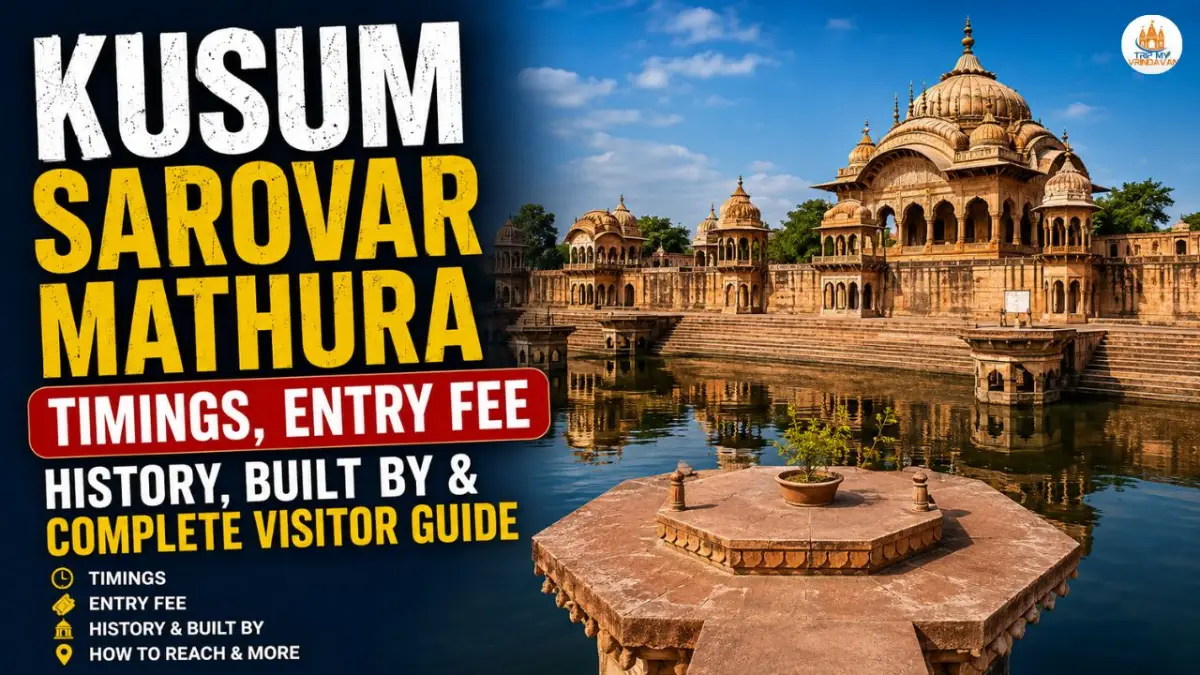
Kusum Sarovar Mathura is an easily overlooked spot in Braj that, while you are focused only on the temples of Mathura and Vrindavan, you will probably miss it. But upon visiting, the mix of a holy water tank, a sandstone structure, a quiet ghat, and tales of Radha and Krishna all combine to make it really unforgettable.
Close to Govardhan, located between Govardhan and Radha Kund, Kusum Sarovar is not only a place to find peace and prayer but also a heritage site to be preserved and protected. The royal memorial-style design, stone chhatris and carved arches of the building beside the pool are especially worth a visit. Moreover, the place is connected with the cultural landscape of Govardhan Parikrama.
A first-time visitor can refer to this guide to get a comprehensive understanding of Kusum Sarovar: its hours, entry fee, location, legend and history, its builder, the Radha-Krishna link, how to get there from Mathura and Govardhan, the best time to visit, what to see nearby and also a few practical suggestions for a comfortable travel.
What Is Kusum Sarovar Mathura Famous For?
Kusum Sarovar owes its fame to both the religious significance of Braj and the 18th century sandstone memorial architectural style. The very name, Kusum, means flower, and the Braj folklore links the place with flower-filled meadows and the Radha-Krishna pastimes.
In fact, the local devotees have a tradition that Radha and her Sakhis came here to collect flowers and that Krishna was the one who came to this place with flower garland for their playful meetings. According to Indian Heritage Tourism, too, they have highlighted how the pool is one of the places which is traditionally linked to Krishna and gopis. Besides that, the water tank has its own story; the sandstone structure built on its bank forms the highlight of Kusum Sarovar.
The chhatris and the memorial structures that make up the complex were erected in memory of Maharaja Suraj Mal of Bharatpur and his family members. Also, the structure was listed as a State Protected Monument of Uttar Pradesh, thereby acknowledging its importance to Braj’s cultural landscape and its significance as heritage beyond its sacredness. If you are looking for a way to disconnect yourself from the busy, commercialized religious spots you might want to consider Kusum Sarovar as part of your tour.
Here, you might enjoy leisurely strolls and watching the beautiful carvings on the ghats as well as the changing scenes reflected in the water, while you get a better appreciation of the way Braj’s myth, pilgrimage and regional architecture intersect.
BOOK: 📞 Call Us: +91 7078723132 | +91 9557104160 📲 WhatsApp Us: +91 7078723132 | +91 9557104160
Kusum Sarovar: Timings, Entry Fee & Best Time to Visit
What are the timings of Kusum Sarovar?
Kusum Sarovar timings, as per the latest Incredible India website listing, have been updated to open up at 6:00 AM and close at 6:00 PM. There are a few travel sites where you will see some variation in the hours listed:
for example, opening time is set at 7:00 AM while closing time is at 6:00 PM or opening at 6:00 AM and closing as late as 7:00 PM.
It needs to be kept in mind that since the site is a heritage and pilgrimage one it is not a regular museum that issues tickets and so the access will greatly depend on the local daylight, condition, and the activities taking place at the site itself. To be safe, just come when there is plenty of daylight and better yet, a bit earlier compared to the listed closing time.
Recommended visiting window:
- Morning: You can enjoy the weather with a little breeze and the peace of the place around 6:00 AM till a few hours later say around 9:00 AM.
- Evening: To enjoy the soft light, you can come a couple of hours before sunset till around sunset around 4:00 PM to 6:00 PM.
Photography in the vicinity is popular at sunrise and just before the sunset for reasons, as the rock face will glow and take on a very nice hue.
Is there an entry fee at Kusum Sarovar?
There is no regular payment you have to make for visiting Kusum Sarovar, which may not be a surprise to you as it is open public space. Most travel articles today say so or have it that you do not have to pay anything if you just want to view the place. Of course, a visitor coming to a place such as this may not be entirely free from expenses such as parking, drinks/snacks, donations, or transportation. This would not really include the case of buying the entrance ticket.
How much time should you spend there?
Mechanically speaking, about half an hour to an hour would suffice for viewing the sacred pool and walking the ghats and seeing all the memorial structures that the place houses, except for those very few who might be there solely to photograph or study, which in some cases could last a couple of hours at the minimum. Travelers undertaking the Govardhan Parikrama will probably not have as much time as they need for the site, as their walking route will continue after that.
Also BOOK: Same Day Mathura Vrindavan Tour Package – Explore the top temples and spiritual attractions of Mathura in one day with a well-planned sightseeing itinerary.
Kusum Sarovar History: Who Built It?
The background story of Kusum Sarovar goes beyond a single historical figure or period. Various aspects of the site belong to different periods of development.
According to the Incredible India site, there was a pond before development which was a natural water body. Around the year 1675 Veer Singh Deo ruler of Orchha, was credited by the people with having constructed the water tank, after developing a reservoir properly. The surrounding area was further worked upon by the local rulers of Bharatpur.
A heritage review of Kusum Sarovar also mentions that Bir Singh Deo in Orchha had the kund turned into a pond in a structured arrangement. It describes that the garden around the reservoir was added for Queen Kishori in a different part of the site history, by Maharaja Suraj Mal (1707, 1763).
The chhatris which are the big dome-like memorial structures, are a later stage of the heritage of the place. One would find that these were the creation of the royal family of the Bharatpur state. Various sources specifically refer that the monument area is dated to 1764 under the Maharaja Jawahar Singh, Suraj Mal’s son. The temple honors Suraj Mal and his queens.
So, who built Kusum Sarovar?
The most exact information is that the kund was originally dug by Veer Singh Deo in 1675 while the later sandstone memorial complex was raised by the Bharatpur rulers, notably Maharaja Jawahar Singh, in the 18th century. That distinction is important as many tourist websites give history in a simplified and inaccurate way, attributing the entire complex to one ruler.
What are the chhatris at Kusum Sarovar?
- Kusum Sarovar, which was an irrigation pond till the mid-nineteenth century, today hosts a garden and heritage area along its banks. In 1923, Kusum Sarovar was declared as a heritage site and later on it was recognized and developed as a National Park.
- The area adjacent to the water features sandstone memorial structures and cenotaphs linked with the memory of Maharaja Suraj Mal (17231763) of the Jat dynasty and his queens, Kishori and Haniya.
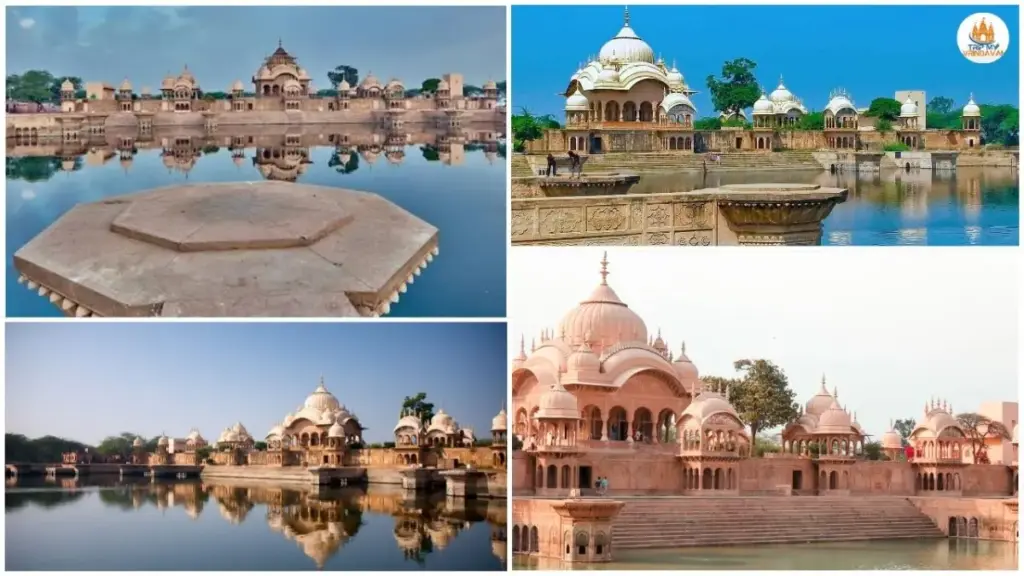
- These monuments are characterized by beautifully carved columns, arches, and decorative motifs, giving them a strongly Rajput and regional architectural flavor. The terrace is yet another architectural feature to be mentioned.
- Getty’s cultural heritage record states that the terrace extends about 140 meters and the architectural style of the building was Rajasthani. Visitors to this place will find that the greatest attraction is the visual juxtaposition of the memorials with the body of water beside them.
- Besides its beauty, the reflections of the monuments in the water make them very camera-friendly, especially in the soft light of morning and evening.
Kusum Sarovar Religious Significance & Radha-Krishna Connection
- Kusum Sarovar, a historically beautiful pond, is also sacred in religious terms. This sacred area of Brajalocality, where pastimes related to Radha and Krishna have been played out, has the location included as part of the sacred landscape.
- According to legend, the name is derived from the flowers as Kusum means flowers, and the locality had lots of flowering trees (Kadamba) and vegetation surrounding the sacred lake.
- Radha and the gopis went there to collect flowers whereas, Krishna went in the same place for playful meetings. In addition, the surrounding sacred landscape contains other important places connected with Krishna bhakti (devotion).
- Kusum Sarovar is located at a very convenient place on the Govardhan pilgrimage as it is between two important pilgrimage sites at Govardhan and Radha Kund.
- Some traditions also consider the Sarovar as a place connected with the saint Chaitanya Mahaprabhu, who once came to this location in the course of his pilgrimage in Braj.
Is Kusum Sarovar part of Govardhan Parikrama?
Yes! Kusum Sarovar is indeed, along the route of Govardhan Parikrama which is a walking tour around Govardhan mountain. One of the most frequently visited spots during this pilgrimage circuit is Kusum Sarovar and, for a pilgrim who is walking or traveling around Govardhan, a visit to Kusum Sarovar would be very convenient and even more so compared with those who only come for Kusum Sarovar.
What to See at Kusum Sarovar
A common mistake people make with regard to a heritage place is that they get out, take one photograph of the place and leave afterwards. But Kusum Sarovar is an ancient site that definitely deserves more than one look, maybe even a few looks.
1. Main Sarovar and the ghats
Kusum Sarovar, the water body itself, is the focal point. The ghats which are in a series of steps are the main elements here that contrast sharply with the green vegetation and sand-colored structures of the area around. Do not go straight from outside to the memorial, just like that. Before you start for the memorial, walk along the outer rim where the view of the Sarovar, the memorial and the entire complex is quite breathtaking. The perspective and scale you get here are incomparable and will make an impression.
2. Sandstone chhatris and memorial architecture
Decorative domes and carved archways are the main elements of this place’s architectural beauty. Inspect the details on pillars, charkha-style openings, stonework, and overall symmetry. The complex reflects the architectural styles and features of the Bharatpur region and is considered as one of the most distinctive sights among the heritage places near Govardhan that are worth visiting.
3. Paintings and decorative details
It is the painting theme in the descriptions that has been used to portray the life of Radha and Krishna and the court of Suraj Mal. If visitors are not able to read the language of the paintings easily, it would help to take on a local tour guide or heritage enthusiast to explain the meanings and context behind the artwork so that the experience is enriching for the traveler. Otherwise, most of them pass these paintings without any clue of what was the significance.
4.Reflections in the water
Photography enthusiasts will find this spot to be very rewarding. The peaceful calm of early morning can lead to very nice reflective shots while the warm glow of late afternoon makes the sandstone look much richer. Phone camera users will find that their mobile device camera does the job well and you will not miss anything out just by not having professional gear.
5. Braj surrounding landscape
Kusum Sarovar is a completely different scene compared to the busy temple area in the center of Vrindavan. One would get to enjoy a very peaceful setting and water bodies, which is very soothing to the mind, a wonderful place for pilgrimage travelers who would love to have few relaxing moments.
Also BOOK: Same Day Mathura Vrindavan Tour Package – Explore the top temples and spiritual attractions of Mathura in one day with a well-planned sightseeing itinerary.
Best Time to Visit Kusum Sarovar
It is usually recommended to see Govardhan and wander across Braj from October to March because the weather conditions at this time make it the most agreeable for such activities.
Furthermore, books on travel and other references generally suggest that it is the cooler seasons when tourists can do more walking around and discovering Govardhan Parikrama and the lovely area around Kusum Sarovar.
Summer
As the summer progresses, the weather becomes unbearable, especially during the daytime. Therefore, it is better to go there very early in the morning instead at midday. It should be specially taken care of if the plan has been to walk along the ghats.
Monsoons
It might be the monsoons which have turned the region into a greener one, and thus, you get a different kind of feeling, but on the other side, rain also gets to slippery walking surfaces. Be sure to include some flexibility in the time of your visits.
Winter
The winter period is usually the best season that one can imagine going on for sightseeing activities. Nevertheless, large numbers of people come on such days that are special in terms of religion that one can say pilgrimage. Hence, if you are looking for some serene moments, it would better be to take an early start.
Festival periods
During the festivals of Janmashtami and Govardhan Puja, as well as other major religious occasions of Braj, a major change in the atmosphere is expected around Govardhan to be brought forth by people and crowds. It will mean that the number of pilgrims will double, and the locals could experience a traffic problem and the timings for transport would be more uncertain.
Festivals Celebrated at Kusum Sarovar
It will be a treat to come across Kusum Sarovar on any days of Braj and Krishna-related festivals. In fact, the place is basically treated as a small sacred kund, historical site, and a great pilgrimage site that pilgrims love visiting.
Janmashtami
Among Braj’s calendar of events, Krishna Janmashtami stands top. People who come to Mathura, Vrindavan, and Govardhan during Janmashtami usually make the visit of Kusum Sarovar part of their pilgrimage. As a result, the surroundings will experience more festive atmosphere, devotional gatherings, and increase in the number of visitors.
Govardhan Puja
Govardhan Puja, is the one that follows just Diwali and has great significance when it comes to Govardhan Hill only. The people from across come to the place on this religious festival along with their offerings for Parikrama and worship, and Kusum Sarovar could be quite crowded during such days.
Holi
It must be the Holi festival that has become the hallmark of the whole of Braj including Mathura, Vrindavan, Govardhan and their neighboring villages. However, the main centers of celebrations like the Barsana’s Lathmar Holi are not at the site of Kusum Sarovar although when the visitors are moving from one holy place to the other they might also get a bit of a taste of the festive spirit going on around them.
Radhashtami
Radhashtami is celebrated to welcome Radha Rani, the most beloved of all. It is one of the main occasions in the region of Braj, particularly around Barsana and Radha Kund. The presence of the place of Kusum Sarovar with Radha Krishna’s pastimes has been the main reason, which has enabled devotees to make it possible for them to be part of a larger pilgrimage in Radha-Krishna during that time.
Kartik Month
In the month of Kartik, Braj is regarded as most sacred of the times for the devotees. One would come to visit Govardhan, Radha Kund, Kusum Sarovar and many others, in fact one who is able to make his own Parikrama is really the best devotee. During those days of Kartik, the atmosphere is generally quite spiritual with a touch of pilgrimage at one every step.
Top 1 Night 2 Days Mathura Vrindavan Tour Plan
Below is the tour plan that allows comfortable pace rather than cramming all possible points of interest into an itinerary.
Day 1: Mathura Sightseeing + Transfer to Vrindavan
Recommended coming in: Early Morning Train travelers will find it convenient to reach Mathura Junction at sunrise time. If you drive from Delhi to Mathura, you will not miss a lot by being early, as you will save on sightseeing.
6:30 AM – Arrive in Mathura
Taking a bite to start the day and doing something to get ready. If at hotel, the room might not be available yet, it is good to let the staff know to keep your suitcases. This way you can start with the tour without worrying about checking in later.
7:30 AM – Shri Krishna Janmabhoomi
Kicking off with the biggest Krishna shrine location of Mathura. Allow about 3, 4 hours based on number of people, restrictions on security, and the level of your stay in the place. Remember only to bring necessary things because rules of security may apply and can be different at various times of the year.
9:30 AM, Dwarkadhish Temple
To your right, follow Dwarkadhish Temple which is another famous Krishna place of worship in the town of Mathura. The temple is one of the essential places for devotees to Krishna. You will have to look at the daily darshan timetable at the temple to plan your visit well, considering that opening and closing times can vary quite a bit around festivals and extraordinary events.
11:00 AM – Vishram Ghat
From the temple, move to the Vishram Ghat, where you will be on the Yamuna. Just sit and chill for some time here. The ghat is very picturesque at the time of sunrise and just after sunset, so if possible, return for the evening Aarti ceremony and the beautiful light display on Yamuna.
12:30 PM – Lunch in Mathura
Your body is hungry: It is time for Mathuri meal. Though the city is renowned for its sweets like Mohan and rasogullas, visitors are advised to opt for places where hygiene is good and that is busy which indicates the place is trusted by local community.
1:30 PM – Travel to Vrindavan
Vrindavan is not far from Mathura but the actual time of travel depends on traffic conditions, state of the road and the period (i.e., the season). Once you reach, drop your bags off at the hotel and rest a little.
3:30 PM – ISKCON Vrindavan
Visit of Krishna-Balaram Temple (popularly known as the ISKCON Temple) marks the beginning of your sightseeing activities at Vrindavan. You will have access to devotional singing, prayers, and the architectural aspects of this beautiful temple complex.
5:00 PM – Banke Bihari Temple
In Banke Bihari Temple, which is one of the main places for any Vrindavan visit, especially for beginners. Be ready for lots of people, crowds may get out of hand especially if you come on weekends, public holidays or on festival days. Also, do not make your plans to get into one place right after another one because crowds in the queues or traffic of pedestrians might mess up your plans.
6:30 PM, Old Vrindavan Market Area
Once you have your darshan, go around the traditional temple marketplace area and you will find:
- Small and humble places selling items for devotion
- Stalls with religious offerings
- Items of sacred use
- Traditional sweet items, desserts, etc.
- Casual snacks of the region
- Countless places of worship apart from major temples
You can leave your bags at the front desk of your accommodation and make sure to lock your valuables in the room. Be mindful if you have to change to crowded ones when moving lanes to avoid being pickpocketed.
7:30 PM, Dinner
You are recommended to dine at the nearby restaurant to avoid the hassle and tiredness of a long-distance trip.
9:00 PM, Hotel Stay
You will only have enough time to do the second day’s schedule of visiting several temples without rest if you rest at night.
BOOK: 📞 Call Us: +91 7078723132 | +91 9557104160 📲 WhatsApp Us: +91 7078723132 | +91 9557104160
Day 2: Vrindavan Temples + Prem Mandir + Departure
The following day should be Vrindavan day mainly.
6:30 AM Early Morning Start
Get up very early, have a meal, and leave your luggage if your hotel can allow it. It may sound surprising but getting up early can be especially helpful on weekends and during the major religious festivals.
7:30 AM Radha Raman Temple
Radha Raman Temple can be a good place to visit in the early morning. It is closely related to the Gaudiya Vaishnava tradition and has great significance in history. The location deserves a place on any list of tourist places when you are looking for something more exotic and less traveled besides very popular sights.
9:00 AM Nidhivan area
If visiting is possible for locals then go to a place known as Nidhivan. Be cautious while you are there and if the regulations do not allow you to go to a particular area avoid the temptation of entering into forbidden places. This is actually one of the places where people would be more respectful rather than trying to click photographs.
10:30 AM Govind Devji Temple
Go to Govind Devji Temple, only if you have spare time. The beauty and design of this temple make it an excellent place to stop on a brief tour in Vrindavan.
12:00 PM Lunch
Have a relaxed and long lunch break. Do not fall into the trap of skipping lunch, thinking that getting one more temple under your belt may be possible. You can soon feel the effects of the scorching weather, tired legs, and hot temple grounds, etc. The people who get heat out of their bodies are more active!
1:30 PM Hotel / Luggage Drop
Get your luggage out and prepare for your exit. If you have a very late departure by train or car then you can add just one more sightseeing spot.
3:00 PM Prem Mandi
The last sightseeing will be the magnificent Prem Mandir with its beautiful architecture that is well illuminated in the evening. Therefore, you must reach there by the time the daylight fades to see the full effect and beauty of the structure.
5:30 PM Departure
The Vrindavan departure can be the beginning of your next adventure towards:
- Mathura Junction
- train journey onwards
- Delhi
- Agra
- Another neighboring location
If the train time allows, you would want to leave your destination a few hours ahead to avoid traffic on the highway.
Plan Your Mathura Trip with Trip My Vrindavan
Embark on the sacred journey to Mathura, Vrindavan Govardhan, Gokul, Barsana, and Nandgaon is an enriching spiritual experience but without the help of an expert, it might seem daunting. There is a lot to take care of starting from the travel route to managing temple visits efficiently.
Trip My Vrindavan has carefully developed pilgrimage tours and local sightseeing packages to provide the perfect balance of comfort, convenience, and a profound spiritual experience. Every aspect of the tour, right from planning the itinerary to the means of transport, has been thoroughly thought out to cater mainly to family and solo travelers as well as short business trips.
Leveraging our local knowledge and efficient travel planning, you will be able to enjoy the Lord Krishna’s sacred territory without the burden of having to take care of all the details yourself.
Benefits of Picking up Trip My Vrindavan
- Hassle-free travel: you don’t need to think about the route, transportation, or travel arrangements
- Itineraries that are customisable: We tailor the tours based on your schedule and preferences
- Local knowledge: We will provide you with a real understanding of the culture and the spiritual significance of the places.
- Comfort and Safety: Trustworthy transportation means and well-organized arrangements to avoid any accidents.
- Time efficient: You will be able to see all the major attractions in the shortest possible time frame.
- Deeper Spiritual Experience: You will be able to focus on devotion rather than the hustle of travel.
Your experience with Trip My Vrindavan will not be just another trip but will lead to a deeply spiritual, peaceful, and unforgettable journey.
Also BOOK: Same Day Mathura Vrindavan Tour Package – Explore the top temples and spiritual attractions of Mathura in one day with a well-planned sightseeing itinerary.
Check out Trip My Vrindavan’s travel packages.
plan your upcoming trip with us and experience a divine journey like never before!
plan your upcoming trip with us and experience a divine journey like never before!
📞 Call Us: +91 7078723132 | +91 9557104160
📲 WhatsApp Us: +91 7078723132 | +91 9557104160
🌐 Visit Our Website: Trip My Vrindavan | Vrindavan Mathura Tourism
🔗Explore all our packages here 👉 View All Packages
🔗 Read Our Blogs for Travel Inspiration: Trip My Vrindavan Blogs
Best Time to Visit During Festivals
Kusum Sarovar, on festival days, can be bustling with people. Visitors should set out early, allow more time for travel by road, and check local details at the place before going there. If you do not want to meet crowds, you can go on a working day to Kusum Sarovar either in the morning or the evening.
Where Is Kusum Sarovar? Location & How to Reach
- Kusum Sarovar lies in the Govardhan region of the Mathura district in Uttar Pradesh, near the road route connecting Govardhan and Radha Kund.
- It is within the Govardhan Hill sacred site. Since the distance by road differs from the point of beginning and route taken it would be best to describe Kusum Sarovar as one of the stops between Govardhan and Radha Kund instead of considering it as a centrally located Mathura destination.
From Mathura to Kusum Sarovar
- Depending on the route and point of beginning, the distance from Mathura to Kusum Sarovar is about 25 to 28 km.
- It takes an hour or so by cab or private car, subject to traffic conditions and the condition of the road. If you plan to visit multiple points around Braj and Kusum Sarovar then a private car is highly advisable.
From Govardhan to Kusum Sarovar
- From the town Govardhan it is only a short distance to the Sarovar.
- That means in a Govardhan sightseeing plan or the Parikrama route it is a very easy extension for the visitors.
From Vrindavan to Kusum Sarovar
- Depending upon the route Vrindavan to Kusum Sarovar distance on road is usually about a low or mid 20-km range.
- It can usually be an hour or a half on the road in normal traffic.
Best way to reach Kusum Sarovar
For the initial visit to Braj covering several places, the most efficient option is a taxi or private car.
This option of travel saves travel time among the various locations and proves quite handy in situations of extreme heat. Autorickshaws, local transport systems may be very appropriate for short distances around Govardhan but availability and comfort can be unpredictable.
How to Reach Kusum Sarovar
Kusum Sarovar lies between Govardhan and Radha Kund at the place of Mathura district of U.P. It is easy to connect it by road besides it is also very simple to get there by train or air via Mathura Junction or the nearby airports.
By Road
Coming via a road is generally the best choice for those visiting several Braj destinations together.
- From Mathura: About 25 to 28 km; by car, it usually takes 45 minutes to 1 hour, considering traffic.
- From Vrindavan: A distance of about 25 to 30 km; it usually takes 40 to 50 mins.
- From Govardhan: A short journey as it is merely a few km. It can be visited on one’s Parikrama or Govardhan sightseeing tour.
- From Delhi: The distance by road is about 150 km; The standard way is to go towards Delhi via Yamuna Expressway towards Mathura, followed by Govardhan and Radha Kund.
Taxis, private cars, buses, and local auto/e rickshaws are available around Mathura and Govardhan. A private car is very helpful when one wants to cover Kusum Sarovar, Radha Kund, Govardhan and Barsana in one day trip.
By Train
- The nearest big railway station is the Mathura Junction Railway Station (MTJ) from which trains go regularly to Delhi, Agra, Jaipur, Mumbai, Kolkata, and several other metropolitan centers. Besides railway,
- you can reach Kusum Sarovar from Mathura by a number of ways. For instance, a private taxi or local transport from Mathura will take you first to Govardhan before reaching Kusum Sarovar.
- One of the convenient options is pre-booking taxis. This will make you very comfortable during the trip in case you are coming with your family or going to do multiple sightseeing stops.
By Air
There is no airport facility at Kusum Sarovar. Here are the best airport options near to Kusum Sarovar: Agra Airport: if flights are available this small and regional airport can be a good option. From Agra you can travel by road to first reach Mathura and afterwards Govardhan.
Indira Gandhi International Airport, Delhi: it is usually the most suitable and largest airport for tourists coming by land from other Indian states or by air.
The distance from Delhi Airport to Kusum Sarovar is about 150-170 km by road, depending on the route. After landing at the airport, the easiest way to reach the destination is by hiring a car or renting one.
Which Is the Most Suitable Transportation Mode for Travellers to Kusum Sarovar?
The majority of tourists find that road travel via Mathura or Govardhan is the most convenient route. For those who are arriving from other cities, a train to Mathura Junction and continuing with taxi would be a logical choice. For those who arrive by aircraft, Delhi Airport will give you the largest variety of connecting flights after which a trip to Govardhan on the road will be required.
Practical Tips for Visiting Kusum Sarovar
- Trivial things like planning can make this visit a lot easier. First of all, arrive when the sun is up.
- Even though some sources cite extended operating hours, the safest planning approach is to stick with the official tourism timing from 6:00 AM to 6:00 PM and do not plan your visit close to their closing time.
- Comfortable shoes: you will be walking on stone ghats and might encounter other challenging types of terrain, especially if you are also doing Govardhan Parikrama.
- Beware of how close you get to water. The steps made of stone at the temple are quite slippery to the point of being dangerous, especially during and just after rains.
- Having your own water is important, especially when the weather is really hot.
- You should bear in mind the religious character of this site. Please keep your volume low and dress modestly, as this is a sacred pilgrimage center.
- Do not litter the water. Part of responsible tourism is keeping the temple water and surrounding heritage area clean.
- Photography is great, but please be respectful. You may photograph the architecture freely, but it is respectful to first ask permission if you would like to take pictures of people during religious rituals.
- Carrying cash comes in handy because although there could be no charge at the entry gate, parking, local transportation, your meals, and some small offerings could be separate.
Places to Visit Near Kusum Sarovar
Kusum Sarovar is particularly good if paired with other places in the Govardhan pilgrimage itinerary for a half-day or full-day tour
Radha Kund and Shyam Kund
These two lakes are very famous religious places, not only in the region of Braj but also throughout India therefore, visiting Kusum Sarovar makes them very logical inclusions on your list of places to go.
Govardhan Hill
At the heart of the whole pilgrimage is the hill of Govardhan, which, in a broader sense, includes temples located around the hill. So, one part of Govardhan Parikrama or a few famous temples of the surrounding region can be paired up with a visit to the Kusum Sarovar as a plan
Barsana
If there is still some time left after having visited all the above-mentioned places, you can even head to Barsana to visit Radha Rani’s holy sites.
A trip starting from the Kusum Sarovar, visiting Govardhan, Radha Kund, and ending at Barsana can be a really pleasant Braj day trip one will not soon forget.
Conclusion
More than just a pond at the foot of Govardhan, Kusum Sarovar Mathura presents a unique convergence of Braj’s spiritual elements, the stories of Radha-Krishna, historical Jat influences, and beautiful sandstone construction within a specific location.
Since the temple entry is free and it also is located along the Govardhan pilgrimage route, it could be quite comfortably included in a Mathura, Vrindavan, or Govardhan trip. However, to actually do a visit and be able to enjoy it well, you are supposed to plan to arrive on the basis of the announced visiting hours, that is, between 6:00 AM and 6:00 PM, to do a morning or afternoon visit, respectively.
It might also be better idea to allow yourself a minimum of 30, 60 minutes to be there and fully appreciate what is on offer. For a more thorough experience of Braj, you are advised to go on a visit that includes Kusum Sarovar, Radha Kund, Govardhan Hill, Daan Ghati, and Barsana, rather than just taking a short glance at the first one and then being on your way.
Also, before planning, it is highly suggested to get the most up-to-date information on the local situation and, more importantly, on crowding levels that are likely to happen on day of a major festival, when there are usually more pilgrims coming for the religious events and ceremonies there.
📞 Call Us: +91 7078723132 | +91 9557104160
📲 WhatsApp Us: +91 7078723132 | +91 9557104160
Frequently Ask Questions About Kusum Sarovar Mathura
What is Kusum Sarovar Mathura?
Kusum Sarovar Mathurais an enchanting place of religious significance with Radha and Krishna. Besides the sacredness, it has lovely sandstone chhatris, ancient ghats, and serenity near Govardhan. The place also serves as one of the highlights for pilgrims visiting Govardhan on a Parikrama.
How far is Kusum Sarovar from Mathura?
Depending on the route and starting point, Kusum Sarovar Mathura is situated between 25 28 km from Mathura. With a privately hired car or taxi, the trip will take almost an hour as a rough estimate, though, with traffic at your back, it could vary between 45 to 60 minutes.
Which temple is the oldest one in Vrindavan?
A widespread belief is that Madan Mohan Temple, in Vrindavan, is one of the oldest surviving temples.
The temple has a historical association with Sanatana Goswami, making it a Vaishnava temple that is representative of early development in Vrindavan.
Which is the oldest temple in Vrindavan?
The temple of Madan Mohan is usually referred to as the most ancient surviving main temple in Vrindavan.
The temple that survived a historical period was built in the 16th century and is one of the earliest records of the Vaishnava tradition.
How far is Radha Kund from Kusum Sarovar?
Radha Kund is only 2-3 kilometers away from Kusum Sarovar. Since they are situated close to each other, it will be convenient for the tourists to visit both Kusum Sarovar, Radha Kund, and Shyam Kund together on one Govardhan tour.
What is the history of Kusum Sarovar?
The history of Kusum Sarovar is quite intertwined with the story of Braj being a sacred place.
This temple site was a kund in the 17th century, while the grand and exquisite sandstone chhatris and other memorials were added by the royal family of Bharatpur in the 18th century.
Where is Kusum Sarovar located in Mathura?
It is situated very near to Govardhan hill at Mathura within the Govardhan area. Kusum Sarovar lies at the crossroads of Govardhan and Radha Kund. It has a special connection with the tradition of Govardhan Parikrama.
Can I visit Kusum Sarovar tonight?
Kusum Sarovar should be visited during the daytime when it is possible to appreciate and explore the beauty of the place. The timings given on the noticeboard are most often around 6:00 AM to 6:00 PM so one should not think of making an overnight visit to Kusum Sarovar. In spite of the fact the place is pretty remote, very little light and very few facilities would certainly be the conditions on such a time slot that you would be the only ones.
What is the distance between Kusum Sarovar to Mathura?
The driving distance between Kusum Sarovar to Mathura comes around 25 28 km.
It will depend on traffic, the condition of the roads, and the starting point of your journey how long the car ride will take you, and you can get a sense of it being around at least 45 minutes to the hour, perhaps a bit more.
What are the Kusum Sarovar timings?
Sarovar usually is open to the pilgrims till 6.00 pm. However, the best times for visiting the place have to the very early in the morning and the dusk as at those times there can be easier breathing and in the daylight, the natural hues of the sandstone are really beautiful.


