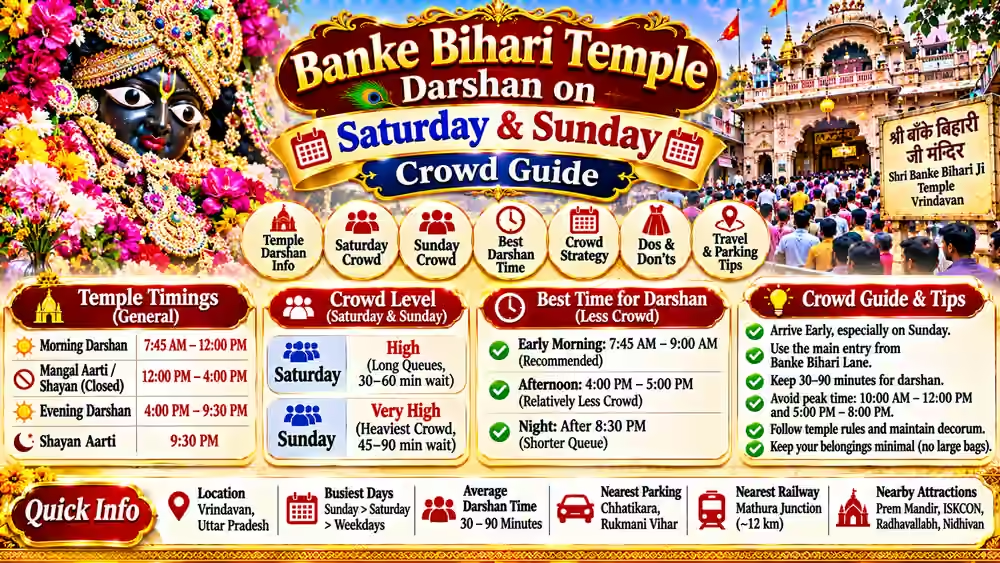


aWinter is not simply a cold weather season for people here in Vrindavan; It is more like darshan itself. The people who normally come are reduced significantly in number. You will enjoy sitting in marble halls when they are colder to you than your body. The thick fog that is present almost all winter hides some of the sounds like that of temple bells, thus, making it quiet. Also the divine figures change their routine according to the season and become less loud in the sense of their presence.
Bhai Dooj (November 11, 2026) is the time to change your schedule. Temples will open up later in the day, closing earlier, whereas the mid-day closure will be short and effective. A person with a mind full of summer timings is the one who would be standing outside of locked portals rather than Thakur in front of him. Hence, if you still consider these timings to plan your darshan in winter, you will definitely waste much time and miss your chance to have Thakur before. Therefore, the timing you set in your mind is not just timing but your attitude towards a situation.
Quick Reference: Vrindavan Winter Darshan Timings 2026–27
Winter darshan in Vrindavan runs from November to February/March, with most temples shifting to a later morning opening and an earlier evening close. Timings can vary by 15–30 minutes on festival days or as the season deepens, so treat the table below as your planning baseline and confirm the day’s schedule locally—especially in December and January, when fog can delay openings.
Key winter takeaways at a glance:
- Banke Bihari shifts from Bhai Dooj (11 Nov 2026): morning opens at 8:45 AM and closes at 1:30 PM; evening runs 4:30 PM–8:30 PM—an hour later in the morning and an hour earlier at night than summer.
- The afternoon closure is universal: every major temple shuts for the deities’ rest and bhog, roughly 12:00 PM to 4:00 PM. Build your day around two darshan windows, not one continuous outing.
- ISKCON opens earliest (Mangala Aarti 5:00 AM in winter), while Shahji Temple closes earliest in the evening (7:30 PM)—sequence your circuit accordingly.
|
Temple
|
Winter Morning Darshan
|
Winter Evening Darshan
|
Key Winter Aarti Note
|
|
Banke Bihari
|
8:45 AM – 1:30 PM
|
4:30 PM – 8:30 PM
|
Shringar Aarti ~9:00 AM; Shayan Aarti ~7:30 PM. No daily Mangala Aarti.
|
|
ISKCON Krishna Balaram
|
4:30 AM – 12:45 PM
|
4:00 PM – 8:15 PM
|
Mangala Aarti 5:00 AM (winter); earliest morning slot in town.
|
|
8:30 AM – 12:00 PM
|
4:30 PM – 8:00 PM
|
Light & fountain show 7:00–7:30 PM (winter).
|
|
|
8:00 AM – 12:30 PM
|
5:30 PM – 8:30 PM
|
Mangala Aarti 4:00 AM (winter); red/green light system at sanctum.
|
|
|
5:00 AM – 12:30 PM
|
5:00 PM – 8:30 PM
|
Historic temple; quieter winter mornings.
|
|
|
6:00 AM – 1:00 PM
|
3:30 PM – 7:00 PM
|
Closes strictly before sunset; no entry after dark.
|
|
|
Radha Vallabh
|
5:30 AM – 12:00 PM
|
5:30 PM – 8:30 PM
|
Mangala Aarti 5:30 AM (winter).
|
|
Shahji Temple
|
8:30 AM – 12:00 PM
|
5:00 PM – 7:30 PM
|
Evening closes earlier than most; plan accordingly.
|
|
6:00 AM – 11:00 AM
|
3:30 PM – 8:30 PM
|
Winter aarti at 6:00 AM and 6:00 PM.
|
The one rule that overrides everything else: every major Vrindavan temple closes in the afternoon for the deities’ rest and bhog. That closure can run from roughly 12:00 PM to 4:00 PM—sometimes longer. Build your day around two darshan windows, not one continuous outing. This single habit separates a peaceful pilgrimage from a frustrating one.
Banke Bihari Temple: The Seasonal Change in Time Slots
The winter season changes will be implemented this year according to the new plan released for the years 2026-27.
The winter time slots summary:
- Early morning darshan from 8:45 AM to 1:30 PM
- Afternoon darshan from 4:30 PM to 8:30 PM
- Cosmetic ritual and the first darshan at about 9:00 AM
- Final religious ritual at around 7:30 PM
- It will come into operation from the day of Bhai Dooj which is November 11, 2026
Main features:
- The transition from the summer routine of 7:15 AM12:45 AM / 5:45 PM9:30 PM to a later morning and an earlier evening.
- Thakur Ji enjoys an additional hour rest during早上; in the evening the gate closes one hour earlier.
- No Mangala Aarti is performed everyday, only once in a whole year, during Janmashtami.
- Periodically lifting of the curtain for darshan, with each glimpse being short and rhythmic.
- Though the temple remains open even during the winter, the number of devotees is much lower compared to the festival days of Holi and the appearance day of the Lord, but still on the weekends as well as on the days of Ekadashi, there are crowds.
Secret: The winter openning time will be later which is very convenient for the family members and the elderly pilgrims, have your full meal breakfast, don't get caught in a cold rush before the sunrise, yet come for the Shringar Aarti. If you are looking to catch the aarti, arrive no later than 8:30 AM, or after 6:30 PM if you just wanna come when the crowd at the temple has somewhat lessened."
ISKCON Krishna Balaram Mandir: Morning Anchor
This is probably the earliest darshan in all of Vrindavan, good for a full day of activities during the winter.
Winter timing snapshot:
- Morning darshan: 4:30 AM, 12:45 PM
- Evening darshan: 4:00 PM, 8:15 PM
- Mangala Aarti: 5:00 AM (winter)
The major points of this temple:
- This temple houses the earliest Mangala Aarti in the whole town so very early dawn and foggy December mornings it is perfect.
- A warm, indoor spiritual experience while everyone else in Vrindavan is still sound asleep.
- Steady kirtan, a covered temple room, and courtyard which is not at all crowded like Banke Bihari's at the same hour.
- The staggered morning openings give you option for having a 2-track darshan day.
Insider tip: Go for Mangala Aarti at ISKCON, then come back to your guesthouse for breakfast and to rest, and finally go to Banke Bihari for the later Shringar darshan. This combination pairs very well during winter as the early hour darshan slots do not overlap.
Prem Mandir: The After Sunset Show
Visiting this temple can give you the most dramatic change of experience depending on the time of the year.
Snapshot of winter time schedule:
- Morning darshan: 8:30 AM, 12:00 PM
- Evening darshan: 4:30 PM, 8:00 PM
- Light & fountain show: 7:00 PM, 7:30 PM (winter)
Main attractions are:
- The performance starts around 30 minutes earlier than in the summer.
- White marble glows in the light of the late afternoon and fountain show starts very soon after early winter sunset has come.
- Clean up time by noontime. You will be able to visit this temple as an evening trip only.
- It's advisable not to try to get through if you arrive after last entry as the gates do not stay open for those who come too late.
Insider tip: To take full advantage of the visit get to Prem Mandir campus from the hours 6:15 6:30 PM. With the time left before the show, you are free do your gallery tours and darshan and to get comfortable. But you won't be able get the complete picture of this amazing building by showing only the main hall at the closing hour of 8:00 PM.
The Little-Known Radha Raman Temple: The Unique Winter Pilgrims' Darshan
At Radha Raman Temple, there is a perfect mix of spiritual intimacy and crowd-freedom. Winter time darshan schedule is:
- Morning darshan: 8:00 AM, 12:30 PM (last darshan at 12:30 PM)
- Sacred night darshan: 5:00 PM, 8:00 PM (final darshan at 8:00 PM)
- Beautiful Morning Prayer: 4:00 AM (a winter speciality! Aarti starts at 4 AM.)
Winter at this temple, the devotees do not have to wait in long queues as they only get up very quickly and are in and out.
The following are the important details:
- The Timing of this prayer changes significantly with seasonal transition; one of the most spectacular transformations in Vrindavan.
- Darshan is indicated by the green light whereas the red light means the deity change is underway.
- The devotees have to patiently wait outside the temple in the darshan queue till the time for darshan opens up again after the deity change even if the time as per schedule is there.
- At winter time devotees are lucky to be at a temple which is not crowded enough not to have to push themselves to get close to the murti.
Hindi-speaking devotes might be the only few to know that a little red light does not mean they should leave but they should wait instead. Doors are opened again shortly.
The Circuit Around: Govind Dev Ji, Nidhivan, Radha Vallabh, Shahji & Rangaji
The winter season is the best time to explore these smaller temples, apart from the main temples that receive a lot of visitors. Each of the following has a unique winter atmosphere.
Govind Dev Ji — The Historic Morning Temple
- Morning: 5:00 AM – 12:30 PM | Evening: 5:00 PM – 8:30 PM
- Grand red-sandstone temple, noticeably quieter in winter.
- Early-morning light on the stone is worth the cold.
Nidhivan — The Sunset-Strict Shrine
- Morning: 6:00 AM – 1:00 PM | Evening: 3:30 PM – 7:00 PM
- Gates close strictly before dark—no entry after sunset.
- Visit the sacred grove in the morning or early afternoon, never in the evening.
Radha Vallabh — The Traditional Seva Temple
📖 Also Read: Mathura Vrindavan Temples & Darshan Guide →
- Morning: 5:30 AM – 12:00 PM | Evening: 5:30 PM – 8:30 PM
- Mangala Aarti: 5:30 AM (winter).
- Deeply traditional temple; the winter Khichdi Mahotsav draws local devotees in December and January.
Shahji Temple — The Early Evening Closer
- Morning: 8:30 AM – 12:00 PM | Evening: 5:00 PM – 7:30 PM
- Earliest evening closure in the circuit—plan it before Prem Mandir, not after.
- A late-evening circuit cannot end here.
Rangaji Temple — The South Indian Rhythm
🎒 Recommended Tour: 2 Days Mathura Vrindavan Tour Package →
- Morning: 6:00 AM – 11:00 AM | Evening: 3:30 PM – 8:30 PM
- Winter aarti: 6:00 AM and 6:00 PM.
- Long midday break (11:00 AM–3:30 PM)—longer than most temples. Time your visit accordingly.
Circuit sequencing rule: Shahji closes at 7:30 PM, Nidhivan shuts before sunset, and Rangaji breaks from 11:00 AM–3:30 PM. Sequence the supporting circuit as Govind Dev Ji (dawn) → Rangaji (morning) → Nidhivan (early afternoon) → Radha Vallabh (late afternoon) → Shahji (early evening), and keep Prem Mandir as the separate evening showpiece.
Winter Darshan Planning: The Details That Make the Difference
Winter darshan in Vrindavan is not hard—it just rewards the pilgrim who plans around the season instead of against it. Below are the four planning details that separate a smooth winter pilgrimage from a frustrating one.
Fog Is a Real Variable
Vrindavan winter mornings are beautiful—and unpredictable.
- Temperature range: Around 7–10°C before sunrise, rising to 20–24°C by midday in December and January.
- Fog risk: Dense morning fog is common and can slow road travel from Mathura Junction, Delhi, and Agra.
- Add buffer time: If arriving by road for a morning darshan, add 30–45 minutes to your travel time.
- Dress smart: Carry a warm layer you can remove by midday—not a single heavy coat.
- The temple rule: Temples do not delay rituals for fog, but your transport might. Leave earlier than you think you need to.
Planning takeaway: Book morning darshan with a fog buffer built in. A 9:00 AM Shringar Aarti is not the time to be stuck on the Mathura–Vrindavan road.
Dress in Layers, Not in Bulk
Vrindavan winter is a study in contrasts: cold mornings, pleasant afternoons, chilly evenings.
- The mistake: One heavy coat that becomes a burden by noon.
- The better system: A base layer, a light sweater, and a scarf you can fold away.
- Footwear matters more than insulation: Choose shoes that slip off easily—you will remove them at every temple.
- Carry a small bag for the layers you shed by afternoon.
- Avoid overdressing for aarti: Temple halls can be warmer than the courtyard outside.
Planning takeaway: Dress for three seasons in one day—cold dawn, mild afternoon, cold evening. Layers give you flexibility; bulk gives you regret.
Build Two Tracks, Not One Long Day
The most common winter mistake: trying to visit four temples between 10:00 AM and 2:00 PM. Every one of them will be closed for the afternoon bhog and rest break.
The better structure:
Track One — Dawn to Late Morning
- ISKCON for Mangala Aarti (5:00 AM) or Radha Raman at dawn
- Then Banke Bihari for Shringar Aarti (~9:00 AM)
- Exit before the 12:00–1:30 PM afternoon closure
Afternoon — The Reset Window
- Rest, lunch, or a walk along the Yamuna ghats
- This is the gate-locked window—use it for non-temple time
Track Two — Late Afternoon to Evening
- Govind Dev Ji or Radha Vallabh in the late afternoon
- Then Prem Mandir for the 7:00 PM light show, or Shahji before its 7:30 PM close
- Sequence Shahji and Nidhivan before Prem Mandir—they close earlier
Planning takeaway: This two-track rhythm respects the Ashtayama Seva tradition and keeps you out of the midday gate-locked window. Two windows, not one continuous outing.
Check Festival Days Separately
Festival days override the standard winter schedule—always verify before you travel.
- Bhai Dooj (11 November 2026) is itself a transition day—the winter schedule begins here.
- Diwali, Govardhan Puja, and Kartik Purnima can extend or shift darshan hours.
- Khichdi Mahotsav at Radha Vallabh draws heavy local crowds in December and January.
- Ekadashi and weekends bring steady queues even in the lighter winter season.
Planning takeaway: Treat the timings table as a baseline, not a guarantee. If your visit coincides with a festival, confirm the day's schedule with your hotel, a local guide, or the temple trust directly.
Book Your Mathura–Vrindavan Winter Tour with Trip My Vrindavan
Winter is the season to experience Vrindavan the way it was meant to be felt—quieter courtyards, intimate aartis, and foggy mornings that turn every temple into a painting. But the season also demands precision: staggered openings, earlier evening closures, and a midday window when every gate is locked.
That is where Trip My Vrindavan comes in.
We track the 2026–27 winter schedule shifts as they happen—from Banke Bihari's Bhai Dooj change to Prem Mandir's earlier light show—and build your darshan itinerary around the actual timings, not generic summer lists.
What we plan for you:
- Temple-wise winter darshan itineraries built around the two-track rhythm
- Guided Braj circuit tours covering Vrindavan, Mathura, Govardhan, and Barsana
- Fog-adjusted morning pickups so you never miss a Shringar Aarti
- Festival-day scheduling for Diwali, Kartik Purnima, and Khichdi Mahotsav visits
- Family and senior-friendly plans that respect the winter pace
Start planning your winter pilgrimage:
- 🌐 Trip My Vrindavan: tripmyvrindavan.com
- 🌐 Trip My Bharat (wider Braj & India circuits): tripmybharat.com
- 📞 Call/WhatsApp: +91 7078723132 | +919557104160
Don't spend your winter morning outside a locked gate. Let Trip My Vrindavan build your darshan day around the 2026–27 timings—so you spend your time inside the sanctum, not outside waiting.